
Arizona’s federally funded fast-charging network is no longer just a plan. The Arizona Department of Transportation (ADOT) has opened the state’s first three stations built under the National Electric Vehicle Infrastructure (NEVI) program, and it’s now taking bids on 49 more. If you own or manage property along one of Arizona’s highways, this round is worth a close look.
The first stations are open
The first three NEVI stations are now live in Tucson (I-10 near Kino Parkway, at Rudy’s Country Store and Bar-B-Q), Green Valley (I-19 at Verde Valley Center), and Wellton (I-8 near Avenue 29 E., at Chevron). Two more are planned to open later this year along I-40 in Seligman and Holbrook, another 11 projects are under construction or in design, and contracts on 14 more are expected by late 2026.
Altogether, ADOT is administering $76.5 million in federal NEVI funding to build as many as 79 stations statewide. For background on how Arizona’s charging plans fit together, see our earlier overview.
What’s out for bid
The new round covers 49 stations with an estimated $49 million in federal funding: 31 new locations plus 18 from the first two phases that weren’t previously awarded. The eligible corridors reach well beyond the interstates, including I-10, I-40 and I-40B, US routes 60, 66, 70, 89A, 93, 180 and 191, and more than a dozen state routes, from SR-64 to the Grand Canyon to SR-347 through Maricopa.
The basics of what ADOT is looking for:
- Location: generally within three miles of the highway, with stations no more than about 90 miles apart.
- Equipment: most sites will have at least four 150 kW DC fast chargers.
- Connectors: most will offer both NACS (Tesla) and CCS plugs.
- Speed: chargers intended to charge a typical EV in 30 minutes or less.
Why it’s a real opportunity for site hosts
Every station is privately owned and operated. Federal funds cover up to 80% of eligible project costs, and the private developer covers at least 20%. No state funds are involved. For a travel center, gas station, restaurant, or retail property near one of these routes, that cost share can turn a fast-charging hub from a long-term idea into a project that pencils out, and bring a steady stream of drivers who stop for 20 to 30 minutes at a time.
The timeline
Proposals are due by 2 p.m. on January 15, 2027. Construction is expected to begin in 2028 and take about a year. Three months goes fast when a proposal needs a site, a power plan, and equipment specs behind it, so if your property is on one of these corridors, the time to start is now.
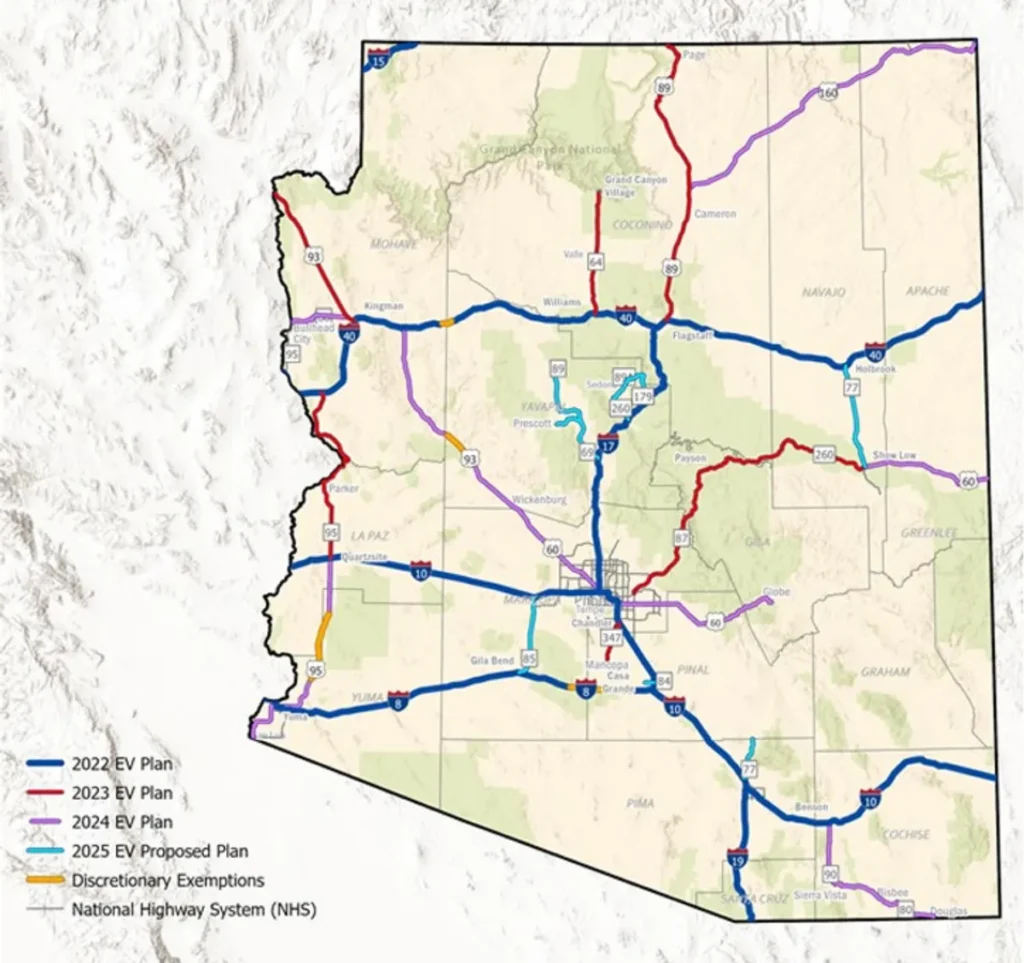
If your site is located near any of the corridors on the map above and you’re looking to take advantage of the NEVI program, talk to EvolvedEV. We can help you figure out which fast-charging equipment fits your location and point you in the right direction to get the project started. Once your station is built, we can keep it online with ongoing maintenance through Evolved360.
Sources
- Arizona Department of Transportation: Arizona’s first 3 federally-funded EV charging stations now open
- ADOT Arizona EV plan: azdot.gov/EVPlan
Featured image: Arizona Department of Transportation